



A Clinician’s Perspective on Fabricating with Adjustable Sockets
When fabrication methods have worked for years,
changing them can feel like adding unnecessary complexity. More components. More fabrication time. More opportunities for something to go wrong.
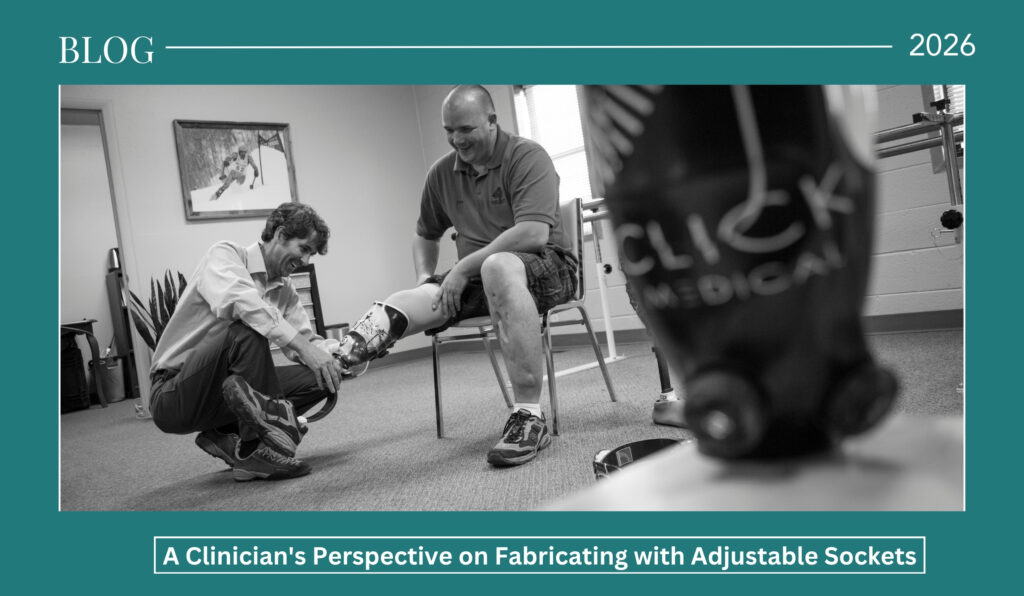
Tyler Hoax, CPO, admits he once approached adjustable sockets with many of those same assumptions.
What convinced him was seeing what happened after patients left the clinic.
“The biggest thing is everyone can make a great socket,” Tyler says. “The question is how well does that socket fit three weeks later, six months later, or a year later?“
For him, that is where adjustability changed the conversation.
Great Socket Fit Doesn’t End at Delivery
Every prosthetist knows that residual limbs are constantly changing. The challenge has never been building a comfortable socket on delivery day, but having the same socket continue fitting well as the limb changes. Without adjustability, clinicians have traditionally relied on sock management and additional follow up appointments to keep pace. Adjustability changes that dynamic.
Instead of reacting to volume changes after they create discomfort, patients can make small adjustments as those changes occur.
Easier Than Most Clinicians Expect
One of the biggest misconceptions Tyler hears is that adjustable sockets are difficult to fabricate. His experience says otherwise. Most of the process remains exactly the same until it’s time to integrate the adjustable system. “The only learning curve really was lacing the dial,” Tyler says. “Once you do it once, you get it.”
He estimates incorporating Click Adjustable Systems adds roughly thirty to forty five minutes to fabrication.
That small investment is quickly recovered by reducing follow up adjustments and unexpected visits.
“It’s not too extensive in terms of fabrication, and I think the benefits greatly outweigh an extra thirty or forty five minutes.”
Thinking About Socket Design Differently
Today, adjustability is part of Tyler’s evaluation before fabrication even begins. When assessing a residual limb, he isn’t only looking at today’s shape. He’s asking what that limb will likely look like six months from now.
Tyler believes adjustable sockets will become increasingly common across the profession.
As reimbursement expands, clinical evidence continues to grow, including recent outcomes research. Adjustable sockets are no longer just a promising idea, they are a proven clinical solution. Research found that people using adjustable volume sockets experienced a 28.1% improvement in socket comfort, along with significant gains in quality of life, satisfaction, and prosthetic mobility. The study also found that greater comfort led to longer daily wear time, providing the clinical evidence practitioners have been waiting for to support what many have already seen in practice: adjustability works.
 English
 Spanish
 French
 German
 Italian
 Arabic
 Ukrainian
 Japanese