



Hinge, Panel, Gap, or Hybrid? Matching Architecture to Clinical Goals
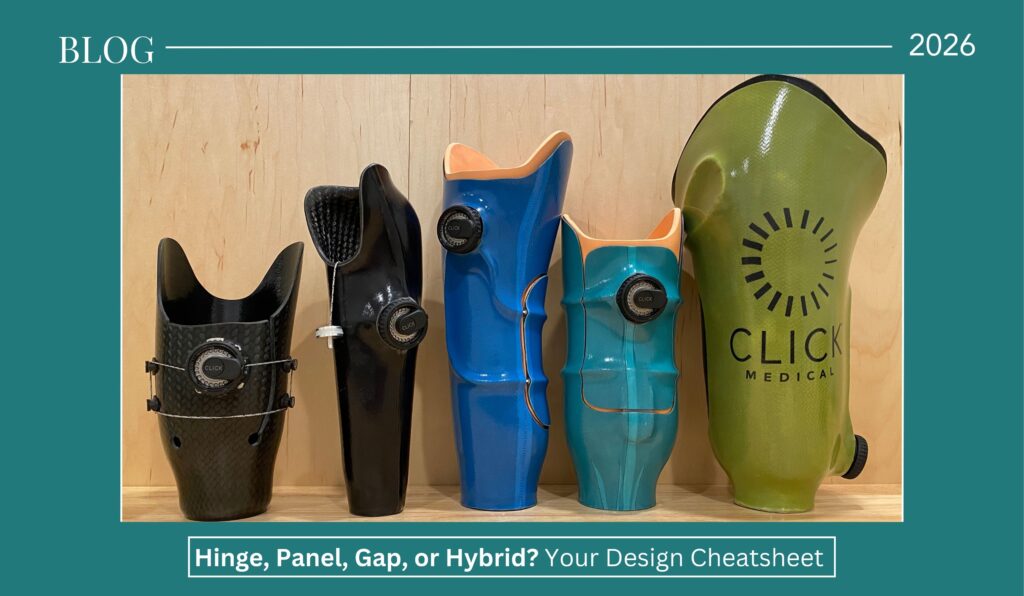
Once limb behavior and biomechanical demand are clearly defined, design becomes the tool. There is no universally superior configuration. There is only what best serves the limb in front of you.
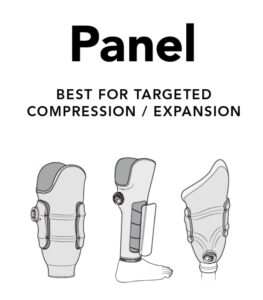
Panel Systems: Targeted Control
Panel systems excel when volume fluctuation or tissue intolerance is regional rather than global. They allow clinicians to apply compression selectively, redistributing pressure without destabilizing the entire interface.
Best For:
- Asymmetric volume changes
- Bony prominence relief (tibial crest, fibular head, adductor channel)
- Patients requiring localized unloading
- High-activity TT or TF users needing selective compression zones
Panels create the ability to adjust one region without altering another. That distinction becomes powerful in limbs with variable tolerance patterns.
Technical considerations:
- Shaving 1 mm off panel edges can eliminate focal irritation.
- Feathered transitions reduce shear at trimlines.
- Backfilling with foam diffuses compression in sensitive areas.
- Panel stiffness should reflect tissue quality, not symmetry.
Panels add value when anatomy demands precision. They add unnecessary complexity when volume change is predictable and global compression would suffice.
Gap Designs: Controlled Expansion 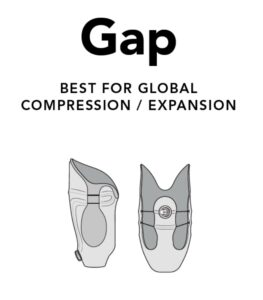
Gap designs allow controlled expansion, making them effective when the limb needs accommodation more than containment. This allows tissue to expand safely rather than forcing compression into intolerant regions, reducing shear by minimizing rigid pressure zones.
Best For:
- Significant diurnal fluctuation
- Edema management
- Sensitive distal anatomy
- Ease of donning for dexterity limitations
Gap designs may reduce ML rigidity if not reinforced properly, and they offer less regional specificity than panel systems. They perform best when the limb wants space, not more targeted compression.
Technical considerations:
- Ensure the frame carries structural load; the gap manages accommodation, not primary stability.
- Size the gap intentionally. Too narrow limits accommodation; too wide reduces control.
- Reinforce adjacent trimlines to prevent deformation over time.
- Route compression to contain tissue without collapsing it into the gap.
- Add soft interface material along gap edges when needed to reduce shear and irritation.
Gap works best when the limb wants space and not more compression.
 Hinged Designs: Improving Entry Pathway
Hinges are frequently misapplied in volume conversations. Their primary function is usability and controlled articulation during donning, not tissue management.
Best For:
- Large limb circumference variation
- Difficult donning pathway
- Short residual limbs with tight entry geometry
Hinges improve donning mechanics and patient independence. They do not inherently solve daily volume shifts.
Technical considerations:
- Foam layering at hinge interfaces can increase compression control.
- Reinforcement preserves long-term durability.
- Alignment must be monitored to protect torque resistance.
Hinges add value when entry is the barrier. They add risk when articulation compromises structural integrity.
Hybrid Designs: When Demands Overlap
Hybrid architecture becomes clinically logical when multiple biomechanical demands must coexist. A TF limb may require proximal containment stability with distal volume accommodation. A TT limb may demand asymmetric swelling control alongside high rotational stability.
Hybrid systems can balance structural rigidity with selective adjustability, but they require clarity of intent. Increased fabrication precision and patient education are necessary. Complexity must be justified by anatomy. Hybrid is not about innovation, it is about solving competing constraints.
Matching Architecture to Outcome
Ask what outcome you are solving for:
- High-activity rotational control? → Panel or hybrid.
- Diurnal volume accommodation? → Gap or global.
- Localized bony irritation? → Panel.
- Difficult donning? → Gap or hinge.
- Proximal TF containment? → Panel or hybrid.
Design is not about preference. It is about tissue behavior under load.
Final Thought
There is no single “best” adjustable design. There is only what is best for this limb, this activity level, and this tissue behavior. When design decisions are grounded in those realities, adjustability becomes purposeful, leading to better outcomes.
 English
  Spanish
  French
  German
  Italian
  Arabic
  Ukrainian
  Japanese